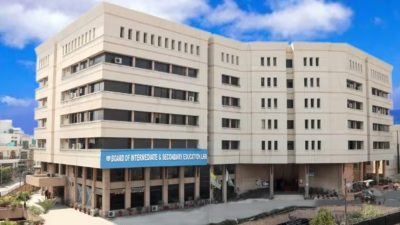
When it comes to education in Pakistan, Punjab stands out as the most populated province. With millions of students appearing in Matric and Intermediate exams every year, it’s natural to wonder:
👉 How many education boards are there in Punjab?
The answer is simple but important: Punjab has 9 Boards of Intermediate and Secondary Education (BISE). Each one is responsible for conducting exams, preparing results, and publishing gazettes for its own region. Let’s break this down in an easy way.
🎓 The Total Boards in Punjab
There are 9 boards that manage education in Punjab. These boards ensure that exams are conducted fairly, results are accurate, and every student gets the same chance—whether they live in a big city like Lahore or a small town in South Punjab.
📋Punjab Boards of Education – Complete List
Here’s the complete list of boards and the districts they serve:
1. BISE Lahore
The oldest and largest board in Punjab. It covers Lahore, Sheikhupura, Kasur, and Nankana Sahib. Famous for handling the highest number of students in Matric and Intermediate exams.
🔗 Official Website: www.biselahore.com
2. BISE Faisalabad
Responsible for Faisalabad, Jhang, Toba Tek Singh, and Chiniot. Known for efficient exam management and timely results.
🔗 Official Website: www.bisefsd.edu.pk
3. BISE Multan
Covers Multan, Khanewal, Vehari, and Lodhran. Provides reliable gazettes and smooth exam services for South Punjab students.
🔗 Official Website: www.bisefsd.edu.pk
4. BISE Gujranwala
Manages Gujranwala, Sialkot, Mandi Bahauddin, Hafizabad, and Narowal. It is one of the busiest boards due to a large student population.
🔗 Official Website: www.bisegrw.edu.pk
5. BISE Rawalpindi
Conducts exams for Rawalpindi, Chakwal, Attock, and Jhelum. Plays a key role in serving students in northern Punjab.
🔗 Official Website: www.biserwp.edu.pk
6. BISE Bahawalpur
Responsible for Bahawalpur, Bahawalnagar, and Rahim Yar Khan. Provides complete gazettes and fair results for southern Punjab.
🔗 Official Website: www.bisegrw.edu.pk
7. BISE Sargodha
Covers Sargodha, Khushab, Bhakkar, and Mianwali. Known for fair exam processes and quick certificate issuance.
🔗 Official Website: www.bisesargodha.edu.pk
8. BISE Sahiwal
Created in 2012, this board covers Sahiwal, Okara, and Pakpattan. Helps reduce workload on nearby boards and brings facilities closer to students.
🔗 Official Website: www.bisesahiwal.edu.pk
9. BISE DG Khan
Manages Dera Ghazi Khan, Layyah, Muzaffargarh, and Rajanpur. Provides services for a large student population in South Punjab.
🔗 Official Website: www.www.bisedgkhan.edu.pk
🟢 Why So Many Boards?
Punjab is the heart of Pakistan’s education system. Millions of students appear in exams every year, and handling them under one board would be impossible. That’s why the province is divided into 9 separate boards.
This system ensures:
- Fair distribution of exam centers
- Timely announcements of results
- Easy access to gazettes and official documents
- Transparency in the evaluation process
🔍 What Do Punjab Boards Actually Do?
Each board has several responsibilities:
- Conduct 9th, 10th, 11th, and 12th class exams
- Prepare question papers and supervise exam halls
- Check answer sheets and ensure fairness
- Announce results online and publish official gazettes
- Handle rechecking requests and issue certificates
By doing all of this, boards play a central role in maintaining the quality of education across Punjab.
📊 Who Oversees These Boards?
All boards in Punjab work under the Punjab Boards Committee of Chairmen (PBCC). The curriculum and textbooks are designed by the Punjab Curriculum and Textbook Board (PCTB). This ensures that every student in the province studies the same syllabus and appears in exams with equal standards.
✨ Benefits for Students
For students, these boards bring many advantages:
- Local access – Each board office is located within the region it serves.
- Quick results – Results are uploaded online and published in PDF gazettes.
- Fairness – Regional boards reduce exam pressure and prevent delays.
- Support – Students can easily contact their board office for help.
✅ Final Words
So, to answer clearly: there are 9 boards in Punjab. Each one is responsible for exams and results in its region. If you’re a student or parent, knowing your board is very important—it helps you find the right result gazette, past papers, and notifications on time.
Punjab’s education boards may be separate, but together they work for the same purpose: providing fair and transparent education opportunities for all students.
👉 For more resources, tips, and complete educational guidance, visit Moosa Learning Hub.